



Table of Contents
- Token costs are becoming a board-level problem
- Vibe coding turns an unpredictable cost into an unpredictable risk
- What the numbers actually look like, side by side
- The conclusion firms are reaching
Get in touch to learn how Genesis can help you modernize your workflows
For the past two years the story financial firms told themselves about AI was simple: it makes things cheaper and faster. That story is getting harder to tell. Token costs, the metered price of every prompt, every tool call and every line an AI model reasons through, are climbing fast, and nobody, not the banks buying AI, not the vendors selling it, can say with any confidence what the bill will be next month.
That’s a serious problem on its own. It becomes a much bigger one when firms are using that same unpredictable AI to vibe code their way to new trading, portfolio management and post-trade applications. Capital markets software has zero tolerance for the kind of governance and cost surprises AI-generated code tends to produce. Below, we look at where token costs are heading, why vibe coding compounds the problem rather than solving it, and what the alternative actually looks like in practice.
Token costs are becoming a board-level problem
WatersTechnology recently canvassed technology leaders across banks and asset managers and found a common theme: nobody has a handle on what agentic AI actually costs to run. The numbers show why. According to the story:
- EY found that a customer service AI assistant costing $0.04 per chat two years ago now costs $1.20, once agentic capabilities are added in, for seemingly the same job.
- A Gartner experiment showed an AI agent processing insurance claims racking up a cost of $2.40 per claim, compared to $1.00 per claim for a workflow built using strict context engineering.
- Nvidia CEO Jensen Huang said a $500,000-a-year engineer is probably burning through at least half that figure in tokens.
The costs are also unpredictable, not just high. A study from the University of Michigan, Stanford, Google DeepMind, Microsoft and MIT, reported by ZDNET, found coding agents can consume roughly 3,500 times more tokens than a turn-by-turn, prompt-based AI chat. Goldman Sachs projects token consumption could rise 24-fold by 2030, and the Financial Times reports vendors increasingly can’t quote a stable price because they can’t predict what a given run will cost.
Even a cheaper token doesn’t mean a lower bill, when volume keeps climbing.
Vibe coding turns an unpredictable cost into an unpredictable risk
For most enterprise use cases, unpredictable AI spend is a budgeting headache. For a bank or asset manager using AI to code new trading and operations software, it’s something worse: a governance problem wearing a budgeting problem’s clothes.
Vibe coding, prompting an AI model to generate an application with minimal structured engineering discipline behind it, has spread quickly through capital markets, driven partly by the need to boost productivity and innovation and partly by leadership pressure to show AI results fast.
Amid the general trend, WatersTechnology found examples of firms pulling back from open-ended, “let a thousand flowers bloom” experimentation with AI-built tools, precisely because the cost of AI usage is giving way to metered, consumption-based pricing that discourages the kind of trial-and-error building vibe coding depends on.
The issue isn’t just cost. It’s that when a probabilistic tool is asked to produce a deterministic result, the outcomes are unpredictable and uneven. Gartner’s 2026 Strategic Predictions warn that prompt-to-app development by citizen developers will drive a 2,500% increase in software defects by 2028, not because the code doesn’t run, but because it’s syntactically correct while remaining blind to the broader system architecture and enterprise rules it needs to respect.
Those defects manifest as failed trades, compliance gaps and audit findings, and by the time they surface, the budget that was supposed to fund innovation is spent remediating them instead.
What the numbers actually look like, side by side
Genesis Global ran a controlled test to benchmark the cost and quality of AI-generated software. In the test, we built a bond trading RFQ workflow application, twice: once with Claude Code alone and once using Genesis Create, our application builder tool that pairs Claude (or other AI) with the capital markets component library and AI guardrails in our framework. Same specification, same underlying model, one variable: whether Genesis’s architecture was doing the work or AI alone was being asked to build from scratch.
The costs weren’t close. The Claude-only build cost $193 in token spend and generated 18,477 lines of code. The Genesis Create build cost $44.70 in tokens, a 77% cost reduction, and needed only 7,446 lines of code, 60% less to test, secure and maintain.
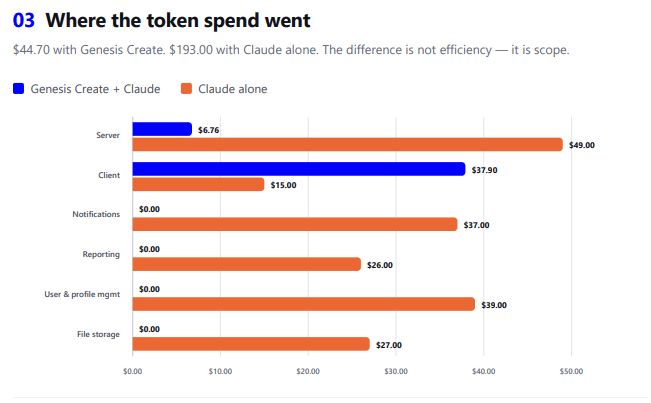
Four of the six capability areas, notifications, reporting, user management and file storage, cost nothing at all in tokens on the Genesis build, because those capabilities already existed in the platform, meaning AI did not need to reinvent them. On the Claude-alone build, those four areas absorbed two-thirds of the entire token budget, money spent re-solving problems that were already solved.
In contrast, in the Genesis build, 85% of tokens were spent where you would expect it: the custom business logic and user screens required by the use case. This is the fundamental value of the Genesis framework. It allows users, including AI assisting builders, to focus their effort on the unique requirements of a new application, not on recreating, critical, but standard attributes (including governance, security and performance) that underpin any financial-markets grade application.
The cost disparity was only the tip of the iceberg. As predicted by Gartner, even more consequential differences lurked below the surface. Genesis engineers reviewed both codebases against the requirements a regulated institution applies before anything goes live, and the Claude-only build failed nearly every one of them.
It stored session tokens in a way that would fail a basic security review. It handled real-time data updates inconsistently across screens. It failed silently when connections dropped, showing an outage as simply “no trades” rather than flagging the problem. It enforced permissions at the page level only, letting users see and click on actions the backend would ultimately reject.
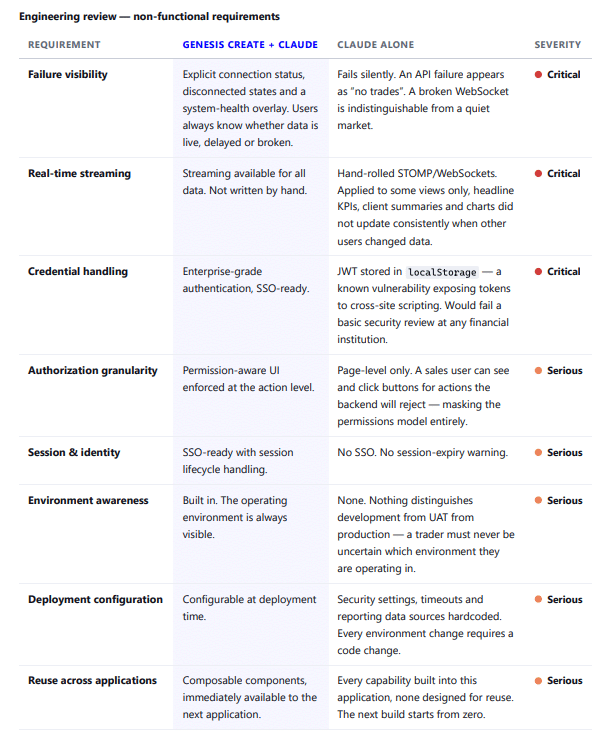
None of that is visible in a demo. All of it is expensive, usually requiring a rebuild rather than a patch, to fix once it’s live. The Genesis Create build, by contrast, inherited enterprise-grade authentication, consistent real-time streaming, explicit failure states and action-level permissions as properties of the architecture it was built on, not as line items someone had to remember to ask for.
Put simply: the AI-alone build wasn’t a cheaper, rougher version of the same software. It was a different, incomplete product that happened to look similar in a walkthrough, and it cost more to get there, a gap that only widens the more an institution builds.
The conclusion firms are reaching
Put the two problems together and the direction is clear. Token costs are rising, they’re volatile in ways nobody, including the vendors selling the tokens, can currently predict, and asking a probabilistic model to single-handedly produce deterministic, regulator-ready financial software multiplies both the cost risk and the governance risk at once.
From a pure spend perspective, vibe coding an application from scratch means re-paying, in tokens, for solved problems like authentication, notifications and reporting on every single build. From a risk perspective, it means shipping software that looks finished without being finished, on an unpredictable budget, into an environment where a silent failure is a trading loss, not an inconvenience.
That’s why AI alone, for all its genuine power, isn’t the answer for financial institutions building production software, and why a framework matters as much as the model underneath it. Genesis pairs the AI models firms already use with a library of components engineered and hardened at some of the world’s largest financial institutions, so that AI’s job narrows to what it’s actually good at: assembling business logic around a foundation that already carries the deterministic guardrails, entitlements, audit trails and real-time infrastructure regulated markets require.
The result, as our study shows, is software that costs less to build, costs less to maintain, and is actually ready to deploy, rather than output that, in reality, is more prototype than production-ready.
The firms that will get the most out of AI in capital markets won’t be the ones that generate the most code the fastest. They’ll be the ones that guardrail AI properly, so speed and governance stop being a tradeoff.